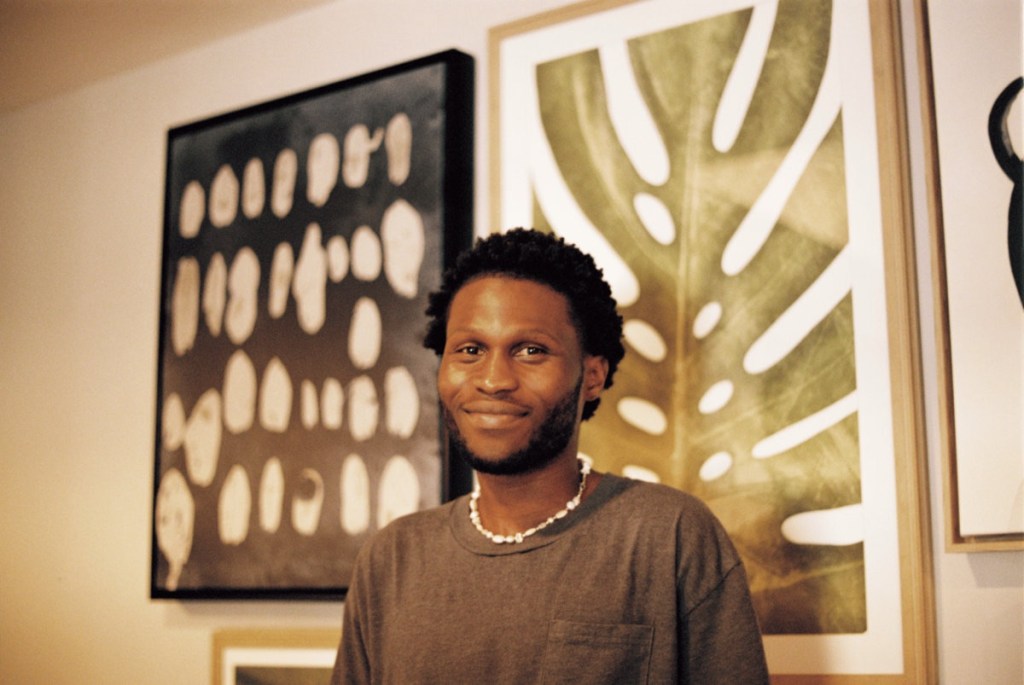
On MAN PLANZ, GOD LAUGHZ, the New Jersey bred, DC based rapper turns acceptance, community and the parts of himself he once tried to escape into the beginning of what he calls his “breakthrough” era.
Before Will Kobus had a collective around him, a collaborative album with producer Poi$un or a catalog built on intense self examination, he had a bedroom, some instrumentals and a reason to keep writing.
For years, that was enough.
Growing up in New Jersey, Kobus says making music was largely an isolated experience. Summers spent at Frost Valley in upstate New York and time with friends in New York City first pushed him toward writing raps, but back home, the practice remained mostly private. An English teacher recognized something in his writing after Kobus reworked several songs into poems for an assignment, but even then, he spent nearly three years writing without much intention of recording or releasing anything.
That isolation gave him room to find his voice before anyone was watching.
By 17, music had become something more serious. Kobus remembers writing a song called “no way out,” the first time he felt capable of carrying one cohesive idea through an entire record.
“The feeling of catharsis I felt putting it together was indescribable,” he said. “From then on it went from a hobby and something I found fun to a real sense of healing.”
That idea, music as a tool rather than simply a product, still sits at the center of his work.
Kobus describes the root of his creativity as “a bit selfish,” though not negatively. He makes music for listeners and the community that has formed around him, but he also makes it because he needs it.
“I’m creating just as much to get through the day,” he said. “Music has always been a tool that’s helped me confront parts of myself and my environment that may have been difficult at points.”
That confrontation becomes the heart of his latest project, MAN PLANZ, GOD LAUGHZ, a full length collaboration with producer Poi$un.

Originally conceived as an EP, the project expanded as Kobus’ life became increasingly difficult to separate from what he was recording. At the time, he was emotionally exhausted and beginning to recognize through therapy that some of the things he once considered healing were actually temporary ways of coping.
Eventually, he was forced to confront what he identifies as a longstanding fear of abandonment and the ways it had shaped his life since adolescence.
That realization changed the meaning of the album’s title.
“Just to be able to say out loud what you’re suffering from takes a lot of courage,” Kobus said. “We all gotta accept that harsh truth. Man plans and God laughs. It just took me a while to move in that knowing.”
Acceptance makes MAN PLANZ, GOD LAUGHZ feel less like a conclusion than the first chapter of something larger.
Kobus made three projects simultaneously while experiencing what he now calls a personal breakthrough. He did not intentionally design them as a trilogy, but after the dust settled, each reflected a different consequence of the same internal struggle.
MAN PLANZ, GOD LAUGHZ examines how his fear of abandonment affected his relationship with his parents. The forthcoming THE HERMIT & THE RECLUSE turns inward, exploring how that fear shaped his relationship with himself, particularly his tendency to become reserved and his effort to challenge it. A third project, TAURUSUN, created with his brother Tijan, looks at how those same patterns can affect romantic love.
“None of them were created with this thread in mind,” Kobus said. “Life found its way into what I was able to make sense of once the dust settled.”
Sonically, the period has also brought Kobus toward what he calls a “return to self.”
His music can move between dense rapping, melodic records and even bossa nova, but MAN PLANZ, GOD LAUGHZ reconnects him with an earlier urgency. Gritty raps and smooth flows sit over production that can feel jarring and familiar at once, giving him room to move freely without being confined to one sound.
Poi$un is central to that environment.
Their chemistry, Kobus says, begins with something more basic than musical compatibility. They are actually friends.
For Kobus, that matters when making something he considers as “sacred as a record.” Their relationship allowed ideas to move naturally and gave both artists enough trust to challenge one another without disrupting the process.
Poi$un handled the album’s production and visual direction while Kobus mixed and mastered the record himself, continuing a practice he has used across much of his own work and Fourth N’Oak releases since 2022.
That same philosophy extends into Fourth N’Oak.
Kobus does not describe the collective as a rap group first.
“Fourth N’Oak is a family,” he said.
After moving into DC following college in 2021, Kobus’ home became a gathering place. Friends came through, spent time together and created. By summer 2022, that circle had developed into what became Fourth N’Oak.
The music followed the relationships, not the other way around.
For an artist who spent his earliest years developing mostly alone, that shift changed how he understood the purpose of creating.
“It takes a village to do this,” Kobus said. “It’s not just about making the songs to me. It’s about building real community around expression and creation.”
That community stretches beyond rap into fashion, art, skating and other mediums. More than anything, Fourth N’Oak represents what Kobus values now: genuine relationships, shared growth and work made with care.
That return to self is becoming more visible inside the music too.
On “NANGA DEF? (ABI SAID),” Kobus draws closer to his Senegalese roots, rhyming partly in Wolof and allowing his heritage to exist directly inside his work. He points to the record as one of the clearest examples of where his head is now.
The choice feels significant. His current era is not only about confronting what hurt him. It is also about getting closer to the parts of himself that were always there.
Being Senegalese, he said, is something he plans to continue blending more deeply into his work, opening another path for his people and upbringing to shine through the music.
That makes his idea of a “breakthrough” more complicated than a career milestone.
It is not primarily about audience size, streaming numbers or recognition. Those things may come, but the breakthrough Kobus describes is quieter and more difficult: understanding where he comes from, naming what hurts, accepting what cannot be rewritten and becoming less afraid to let other people into the process.
By the end of MAN PLANZ, GOD LAUGHZ, Kobus does not ask listeners to see him as healed or fully figured out.
He wants them to understand something simpler.
“I care,” he said. “I put a lot of time and love into my craft and I hope it presents in the work I share.”
For someone whose music began as something he kept almost entirely to himself, that willingness to share may be the breakthrough itself.



Leave a Reply